
A script that quotes its sources, and three gates that only a person can open.
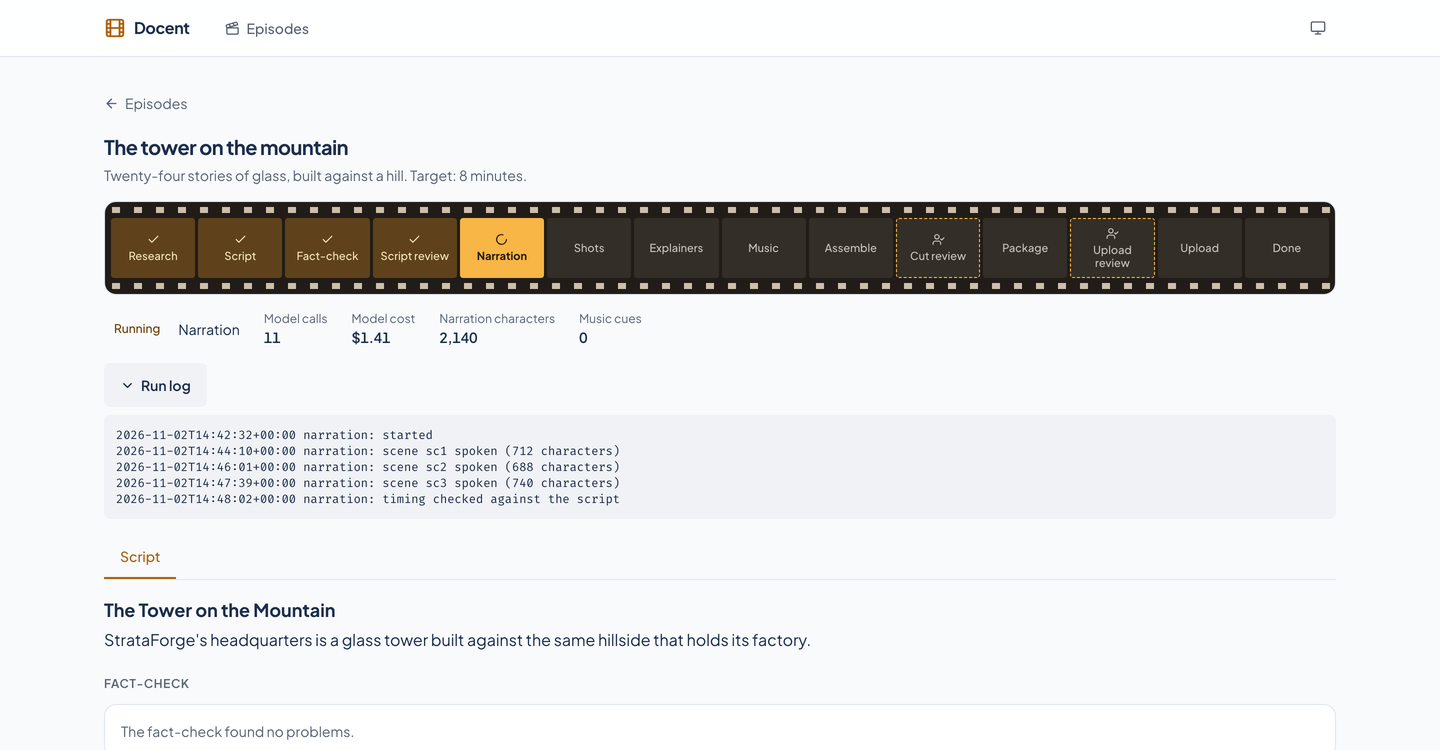
Docent runs an episode through a fixed list of stages and stops at three of them. Between the gates it does the work: research, writing, checking, narration, pictures, diagrams, music, and assembly. At each gate it waits for someone to read, watch, and decide.

From topic to private upload
An episode is at exactly one stage, and a run advances until it reaches a gate.
Requesting changes at script review sends the episode back to the script with your notes. At cut review it goes back to shot planning, and the narration is kept. Editing a scene's narration during script review sends the episode back to the fact-check, so new wording is checked before anyone approves it.
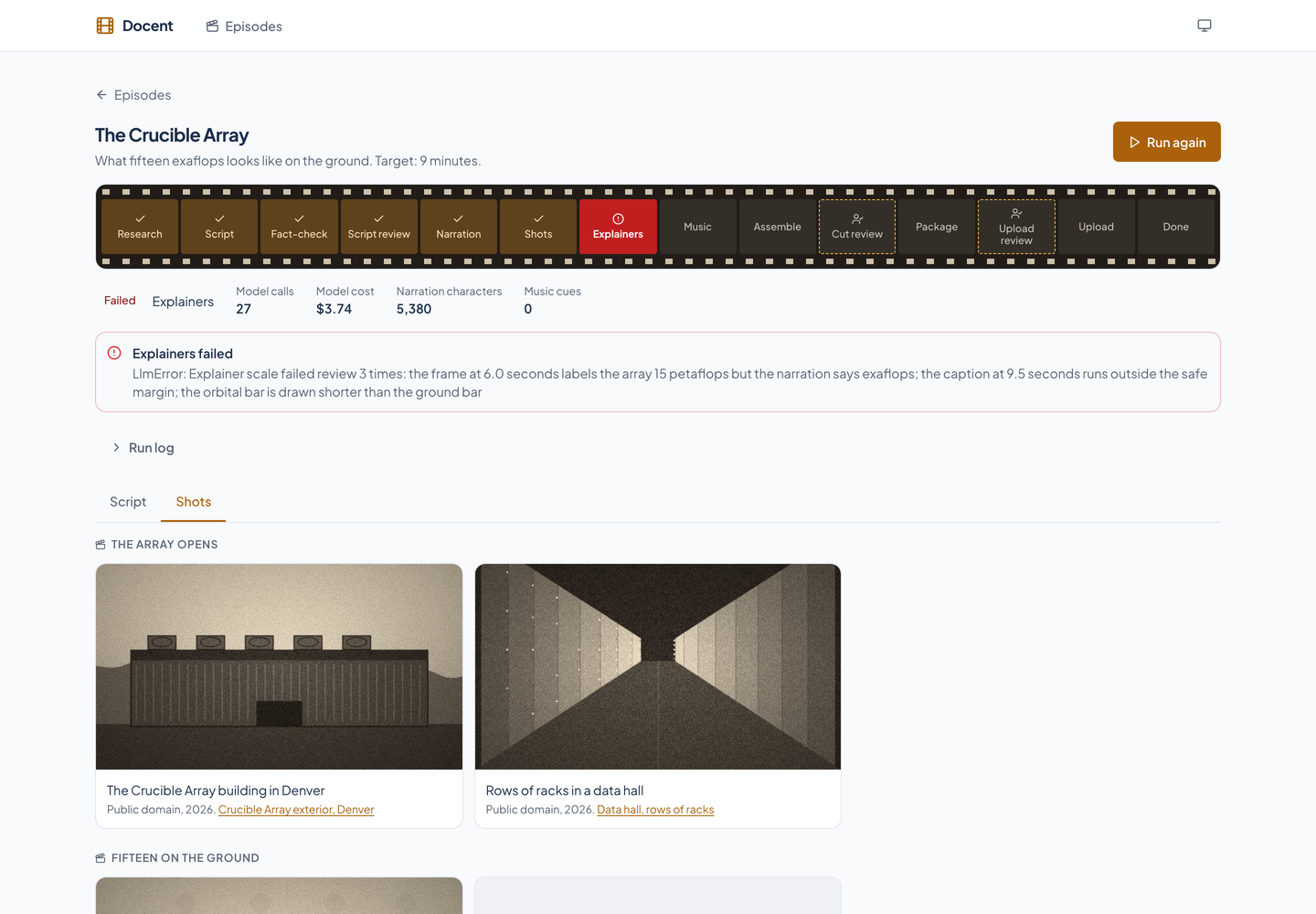
If a stage fails, the episode stays at that stage with the reason, and running it again resumes from there. Finished stages never repeat. A run records its process, and if that process is gone the next read reports the run as failed instead of leaving it looking busy.
Research
Docent finds sources, from your seed addresses and its own searches, and stores a text snapshot of each one.
Script and fact-check
The writer gets only the stored text and must attach a verbatim quote to every claim. Code checks the quotes, and a second reader checks the support.
Script review (gate)
You read, edit, send back, or approve. Narration, which spends credits, starts only after this.
Narration, shots, explainers, and music
The script is spoken with word timing, each beat gets a public-domain picture or film, mechanisms get an animated diagram, and an underscore covers the film.
Assembly and cut review (gate)
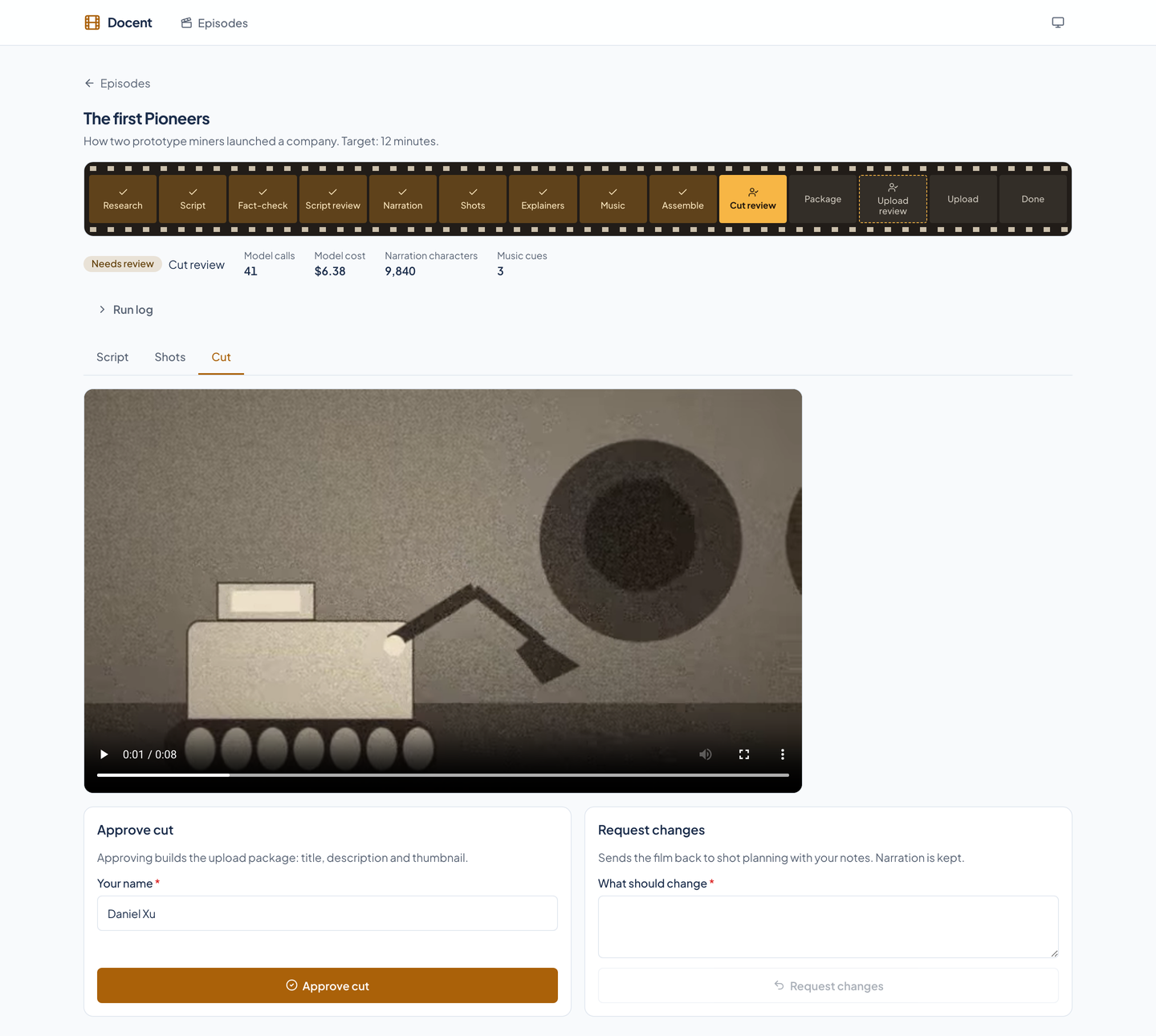
An MP4 is assembled with subtitles and chapters. You watch it and approve it or send it back to shot planning.
Package and upload review (gate)
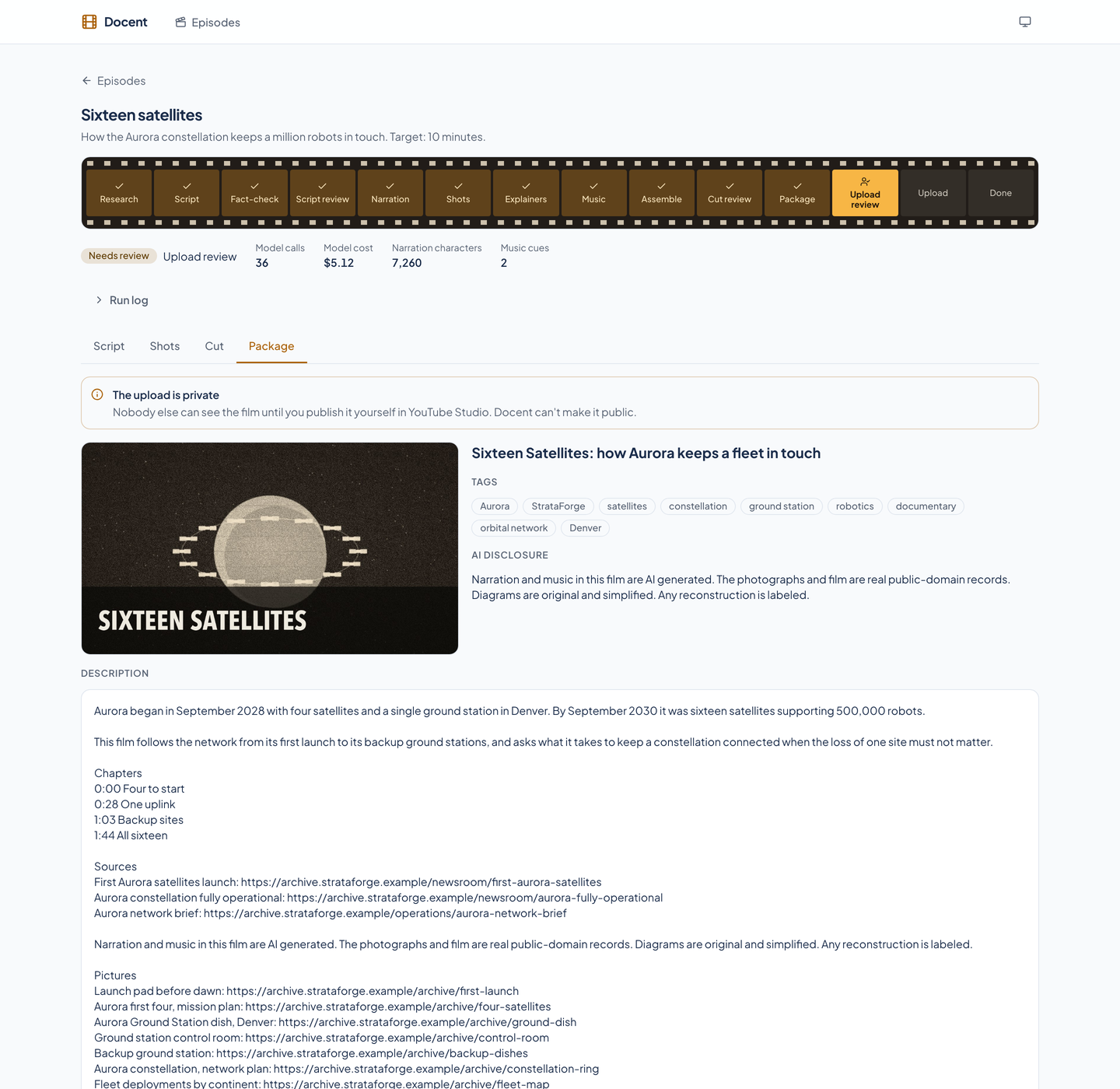
A title, description, tags, thumbnail, and AI disclosure are built. You approve, and the film goes up as a private video.
Claims that cannot be invented
A script is only as honest as its checks, so the checks are code wherever code can do them.
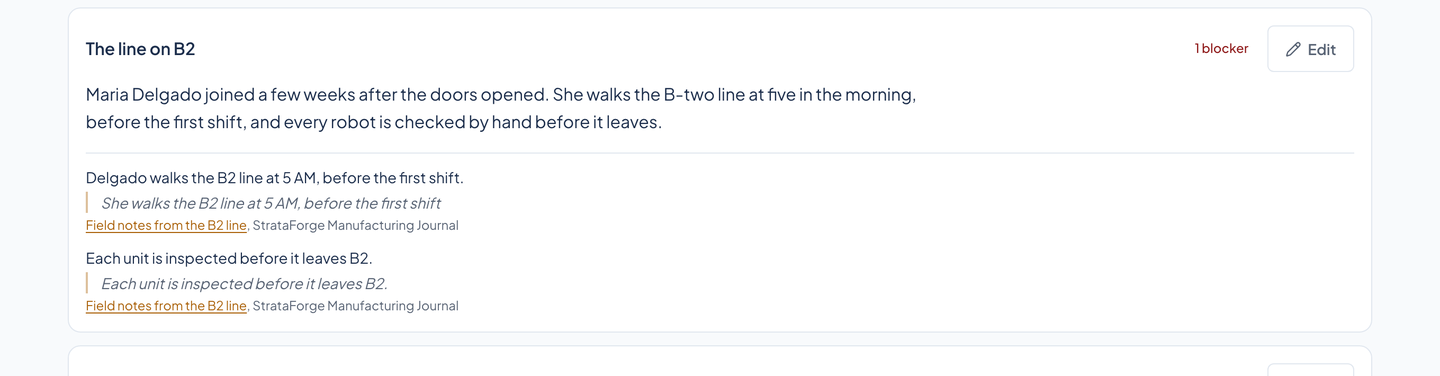
Research stores what each source said. The writer sees only that text, and every factual claim in a scene must carry a quote from it. The check normalizes whitespace and quotation marks, then looks for the quote in the snapshot. A quote that is not there is a failure the writer is sent back to fix, not a judgment for a person to catch.
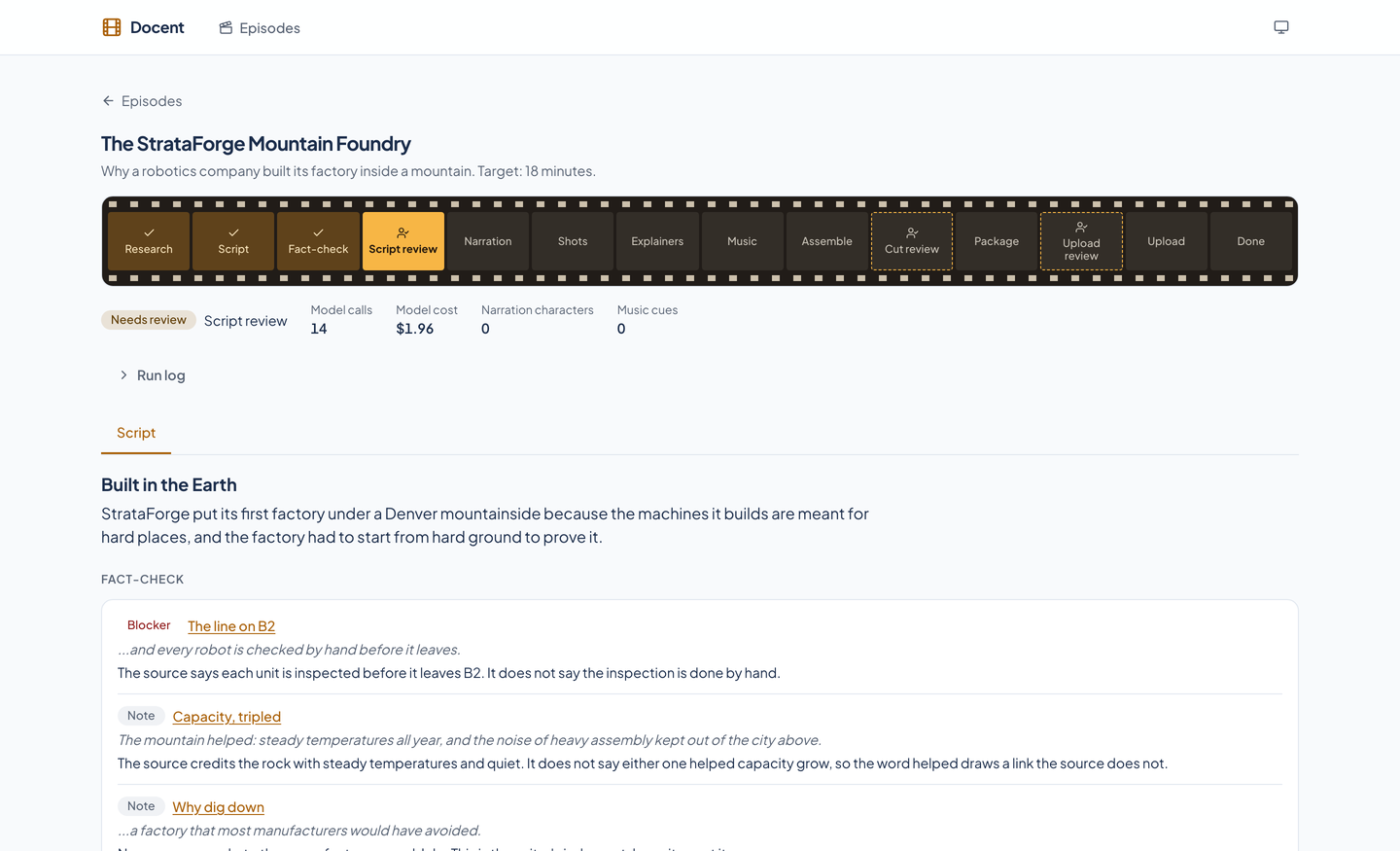
A real quote can still be stretched. The fact-check sends each scene, with only its cited sources, to a call that has no tools and did not write the script. It returns findings. A blocker holds the script gate until the reviewer says they have read it, so a problem can be overruled but not overlooked.
Facts from a model's own knowledge are not allowed in a script. A model answer that breaks a rule goes back with the violation, and code never patches it into shape.
| Checked by code | That every quote appears in its stored source, and that narration, claims, and sources line up |
|---|---|
| Checked by a second reader | That the cited text really supports the sentence, scene by scene, from only the sources the scene cites |
| Decided by a person | Whether a blocker is overruled, and whether the script is approved at all |
Pictures a model can only choose from
A documentary shows real pictures where they exist, and shows where each one came from.
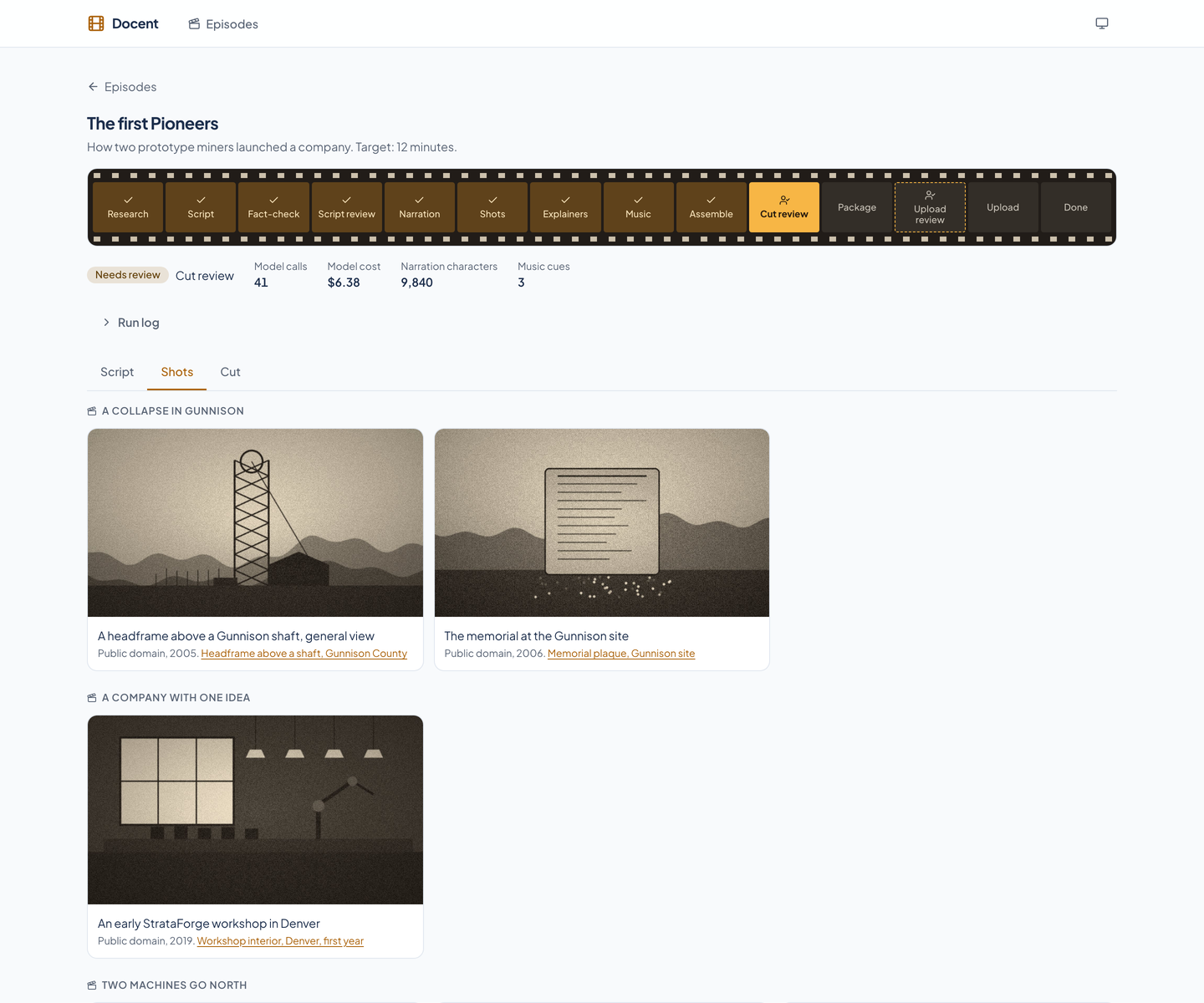
For each narration beat, Docent plans a shot anchored to the exact words it illustrates, writes searches for Wikimedia Commons, and shortlists candidates from the files' own records. It then reads a contact sheet for the scene and picks a labeled candidate for each beat. A separate pass reads the full picture and can veto the pick. A vetoed beat gets one new choice and is then dropped, and its neighbor holds.
A candidate counts only when Commons' license field says public domain, and a credit that names a wire service is refused even then. Labels are the only thing a model can return, so nothing unlicensed can reach a cut.
- Archive film: up to two films are downloaded and sampled every six seconds, and a model lists the usable stretches. A moment shorter than its beat is refused.
- Explainers: for a mechanism, a model writes one animated diagram from a real example. It is linted, its frames are looked at against the narration, and a failure goes back with the reason, up to three times, before the stage fails.
- The shot plan shows every picture with its license, its date, and a link to its record.
The three gates
A gate is a person's act. Nothing in Docent can open one for them.
Approving a gate needs a reviewer's name and is recorded with the time and an optional note. At script review, approving with open blockers also needs a tick to say they have been read. The API refuses an approval for a gate the episode is not at.
The MCP server has no approve tool, and there must never be one. An assistant can create an episode, run it, and read everything a reviewer reads, then send it back with notes, but only a person can approve.
| Script review | Read the script beside its sources and the fact-check; edit a scene, approve, or request changes. Approving starts narration. |
|---|---|
| Cut review | Watch the film; approve it, or send it back to shot planning with notes. Approving builds the upload package. |
| Upload review | Read the title, description, tags, thumbnail, and AI disclosure; approve to upload the film as a private video. |
Disclosure, privacy, and spend
Three rules the pipeline holds to without being asked.
- AI is disclosed. The credits, the description, and the upload's synthetic-media flag all say that narration and music are AI generated.
- Uploads are private. The upload's privacy setting is a constant, not a parameter, so no code path can publish a video.
- Spend is capped. Each episode has caps on model calls, narration characters, and music cues (120, 60,000, and 12 by default), checked before each spend and shown on the episode's page.
| Record | Holds |
|---|---|
| Brief | The topic, angle, target length, and seed addresses |
| State | Stage, status, approvals, history, error, and reviewer notes |
| Sources and script | The stored snapshots, the scenes, the claims, and the fact-check |
| Narration and shots | The spoken scenes with word timing, and the shot plan with each picture's license |
| Output | The film, subtitles, chapter times, thumbnail, and package |
| Ledger | The counts behind the spend caps |
Questions about this tool?
Write to Renkara Media Group and a person will answer.